Why now?
Because ordinary personalisation has stopped being a differentiator, and shoppers can tell. 76% of consumers say online shopping lacks excitement (Criteo, 2025). Meanwhile the cost of guessing keeps compounding: about 2 in 3 shoppers buy multiple sizes planning to return some (NRF/Happy Returns 2025), and with Australians spending A$11.6bn on fashion online in 2025 at 20–30% return rates, fit uncertainty is a line item, not an anecdote. McKinsey's research adds the commercial frame: faster-growing companies earn 40% more of their revenue from personalisation. The question is no longer whether to personalise — it's which level you personalise at.
The Five Levels of Personalisation
A useful way to place any tool (including ours) is a ladder we use with brands:
- Level 1 — Segmented marketing. Audiences, email flows, "customers like you". Personalised messaging, generic store.
- Level 2 — Personalised recommendations. "You might also like." Changes the product list, not the experience.
- Level 3 — Personalised discovery. Semantic search and sorted collections: "linen for a summer wedding" understood as meaning, not keywords.
- Level 4 — Personalised product. Virtual try-on and size advice on a single item, on demand. Useful, but one modal at a time.
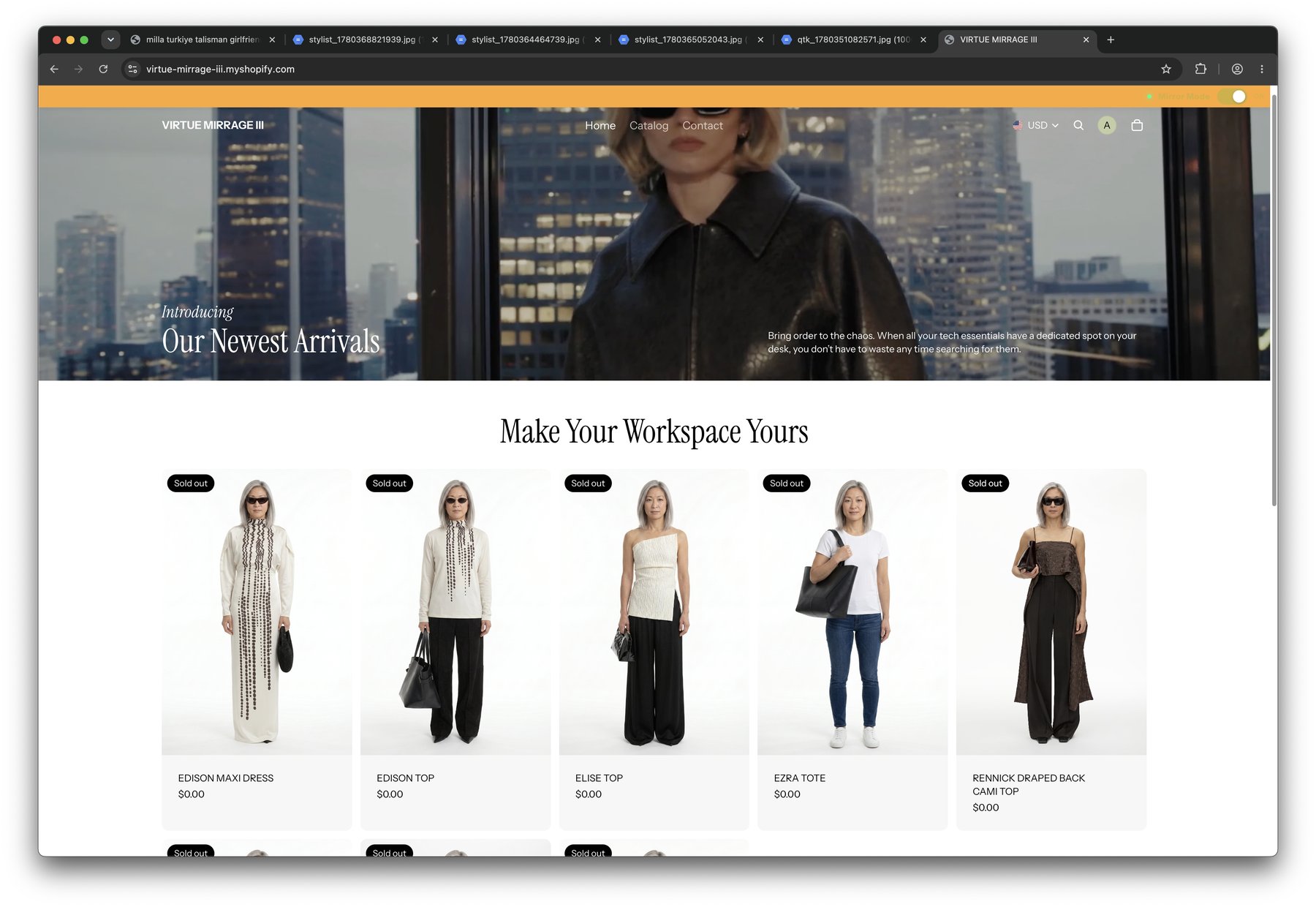
- Level 5 — The personalised store. Hyper-personalisation: the imagery itself becomes the shopper — every page, every drop, pre-generated, with fit, styling and identity layered on. A size-16 customer sees a size-16 body on every image, not a size-6 model.
Most fashion stores in 2026 sit at Levels 1–2. The try-on app wave is Level 4. Level 5 is new — we believe Virtue Mirage is the first platform operating there — and it's less a feature than a different definition of what a storefront is.
How Level 5 actually works
- A persistent identity, created once. The shopper builds a Digital Twin from two photos — or just typed measurements, no photo needed. Real measurements either way.
- The imagery, store-wide. Every product page, grid and collection renders on the Twin — not a widget on one page.
- Pre-generated, not on-click. New arrivals render in the background; the shopper opens the store and it's already them.
- Advice on top. Centimetre-level fit guidance, size recommendations, a semantic stylist that shows rather than tells, outfits completed visually.
- The shopper in control. A toggle between the brand's photography and themselves; photos deleted after the Twin is built; consent gates on everything that travels.
What should a brand or merchandiser actually do?
- Locate yourself on the ladder. If you're at Level 1–2, a semantic search or recommendations engine (Level 3) is a sensible next rung.
- Fix fit before style. Fit drives the majority of apparel returns; size advice from real measurements pays for itself first.
- Choose scope deliberately. One category → a try-on specialist. The storefront as identity → a hyper-personalisation platform. Our honest guide to the 2026 app landscape maps the options, competitors included.
- Demand "up to" numbers. Benchmarks (up to 10–23% conversion, −20–40% returns, +12–18% AOV) are directions, not promises. Measure on your own store.
- Keep the customer in charge. Personalisation that can't be switched off reads as surveillance. Opt-in toggles and deleted photos are what make it welcome.
Virtue Mirage runs whole-store hyper-personalisation on Shopify and BigCommerce today — book a 20-minute demo or install it from the Shopify App Store. Watch the 4½-minute film for the whole picture.
FAQ
What is hyper-personalisation in fashion e-commerce?
Personalising the storefront itself, not just the product list: every product image, grid and collection is rendered onto the shopper's own Digital Twin at their real measurements, automatically and in advance. Recommendations personalise WHAT you see; hyper-personalisation personalises what you SEE it on — you.
How is hyper-personalisation different from virtual try-on?
Virtual try-on is one product, on demand, usually in a modal. Hyper-personalisation is the whole store, persistent and pre-generated: the Twin is created once and every page, new drop included, is already rendered on the shopper before they log in. Try-on is Level 4 on the personalisation ladder; hyper-personalisation is Level 5.
What are the Five Levels of Personalisation?
Level 1: segmented marketing (emails, audiences). Level 2: personalised recommendations (you might also like). Level 3: personalised discovery (semantic search, sorted collections). Level 4: personalised product (virtual try-on, size advice on single items). Level 5: the personalised store — hyper-personalisation, where the imagery itself becomes the shopper, everywhere, automatically.
How does a fashion brand get to hyper-personalisation?
The practical path: capture a real-measurement identity (photos or typed measurements), personalise the imagery store-wide rather than per widget, pre-generate so nothing waits on a click, add fit and styling advice on top, and keep the shopper in control with an opt-in toggle. Platforms exist for this — Virtue Mirage is believed to be the first — or a brand can build towards it level by level.