What is Virtue Mirage?
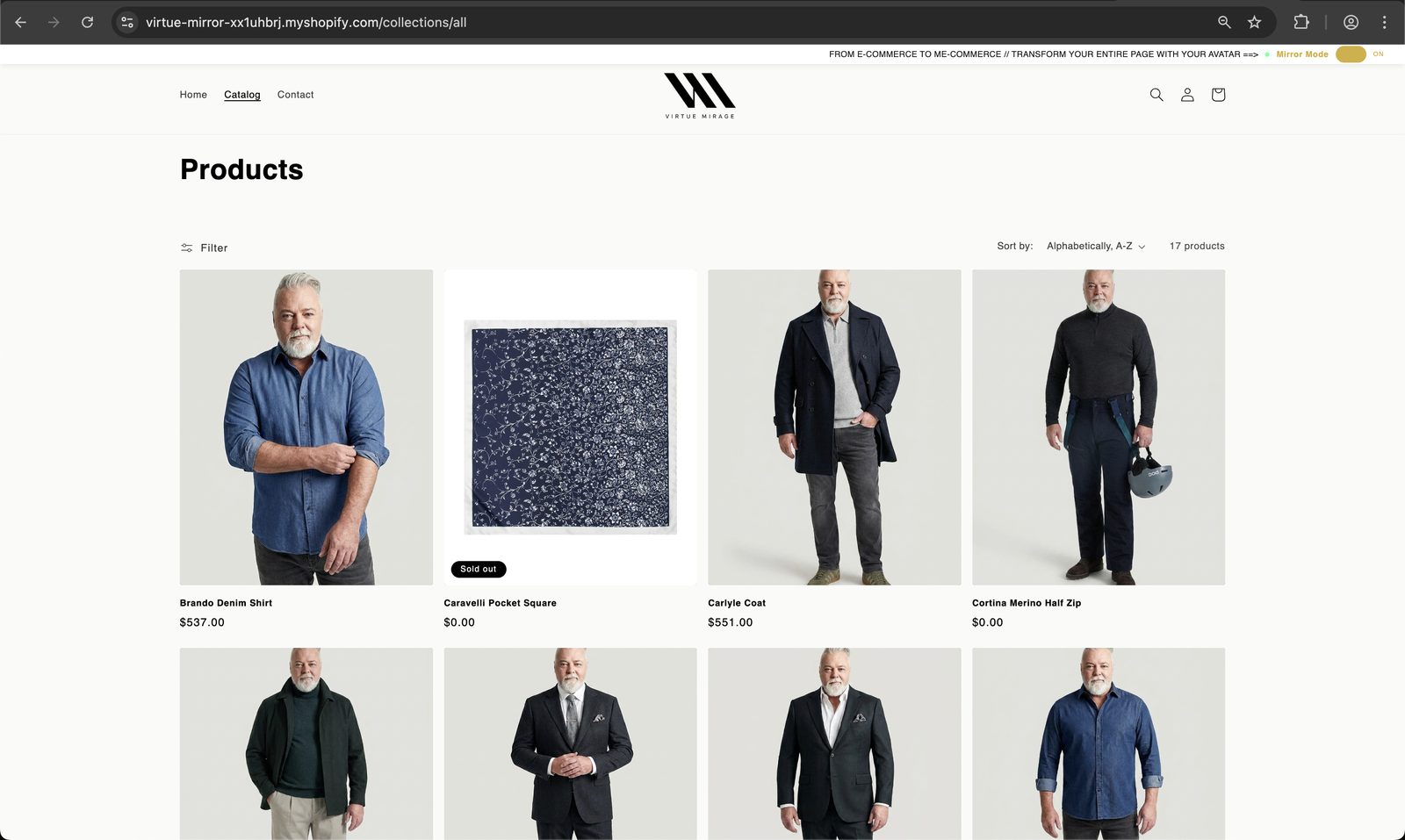
Virtue Mirage is an app — on Shopify today — that replaces the model on every product image with the shopper's own AI avatar. The customer uploads two photos once — a portrait and a full-body shot — and in about ninety seconds the platform builds their Digital Twin. After that, the entire storefront re-renders on them: product pages, collections, the new drop that landed this morning. They don't browse your store. They wear it.
Crucially, it renders them at their size. From the same two photos, the platform reads the shopper's measurements — so the avatar isn't a generic size-6 model. A size-14 customer sees how the dress actually falls on a size-14 body. Virtue Mirage is the bridge between the model and the mirror.
And it isn't tied to one platform: the full experience is live on Shopify and BigCommerce today, and a drop-in SDK and API bring try-on, sizing and the network to anything else — headless, custom, or in between.
That's the line we keep coming back to, because it's the whole idea: from e-commerce to me-commerce. For fifteen years our parent studio, Virtue Creative, has shot premium fashion campaigns for 500+ brands. Virtue Mirage is that studio's eye, built into software — so the personalised images hold the same bar as the photography they replace.
It's tempting to file this under "virtual try-on." It isn't. Try-on is one feature. What Virtue Mirage actually sells is a storefront that is different for every single customer who logs in.
Why fashion e-commerce needs this now
Two problems have been quietly eating fashion margins for a decade.
The first is sameness. Every store online shows the same stock model in the same studio light — and that model is usually several sizes smaller than the average shopper. So shoppers can't tell whether the dress will look like that on them, at their size. They hesitate, they bracket-buy, or they bounce. Online apparel converts at a fraction of the in-store rate, and the gap has barely moved.
The second is returns — and the numbers are brutal. The average online apparel return rate sits around 24–26%, and in some fashion categories (swimwear, formalwear) it climbs past 30%. Fashion returns run roughly 25% online versus about 3% in-store — almost the entire difference is that people can't see the item on their own body before they buy. And the single biggest reason they send things back is fit: studies attribute up to ~70% of apparel returns to size and fit alone. Every one of those returns is shipping, processing, and lost margin.
Both problems have the same root: the customer can't see themselves in the product. Virtue Mirage removes that root cause — not for one hero item, but across the whole catalogue.
How it works
It's deliberately simple for the shopper and zero-engineering for the brand.
- Create the Digital Twin (once). Two photos, ~90 seconds. The original photos are deleted immediately after the avatar is generated — we never store raw images.
- The whole store transforms. Every product page renders on the customer. A Mirror Mode toggle lets them flip between your photography and themselves anytime — they're always in control.
- New arrivals convert automatically. When you drop a new collection, the system pre-renders every eligible customer wearing every new piece in the background — before they next log in. They open the store and the new drop is already on their body.
- Guests still get a taste. Not logged in? A no-account Quick Try-On lets a guest upload one photo and see a product on themselves in under a minute — and captures a consented marketing lead for you in the process. No app, no account.
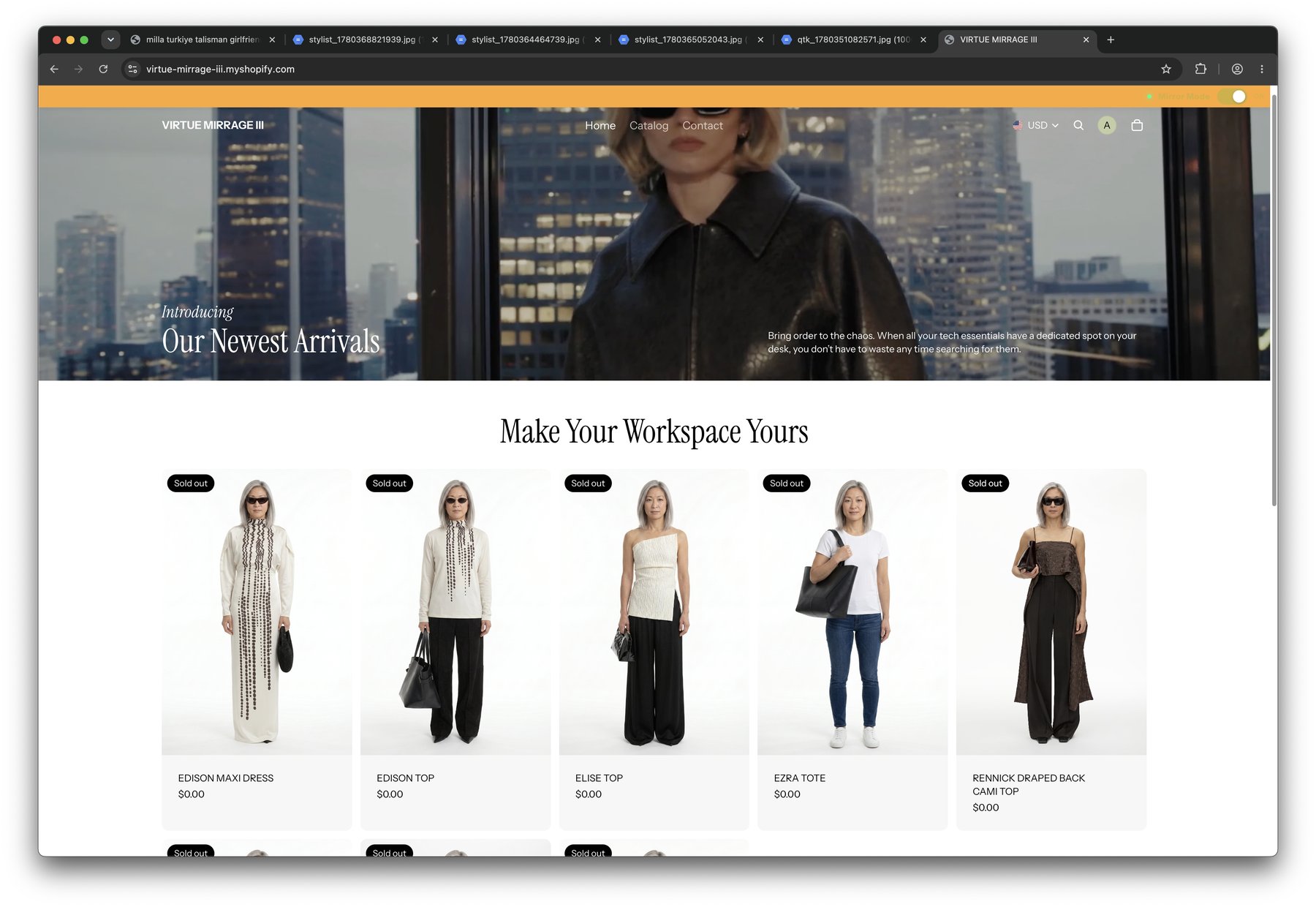
It installs as a Shopify Theme App Extension — Liquid, Dawn, Horizon, custom — with no rebuild and no headless migration. Setup is measured in minutes.
What makes it different from a virtual try-on app
This is the part that matters for anyone comparing tools. Most try-on apps put one product on a generic model or a single uploaded selfie. Virtue Mirage is a personalisation platform, and five things set it apart:
- Whole-store personalisation, not a widget. The entire catalogue becomes the customer, automatically, on every new arrival.
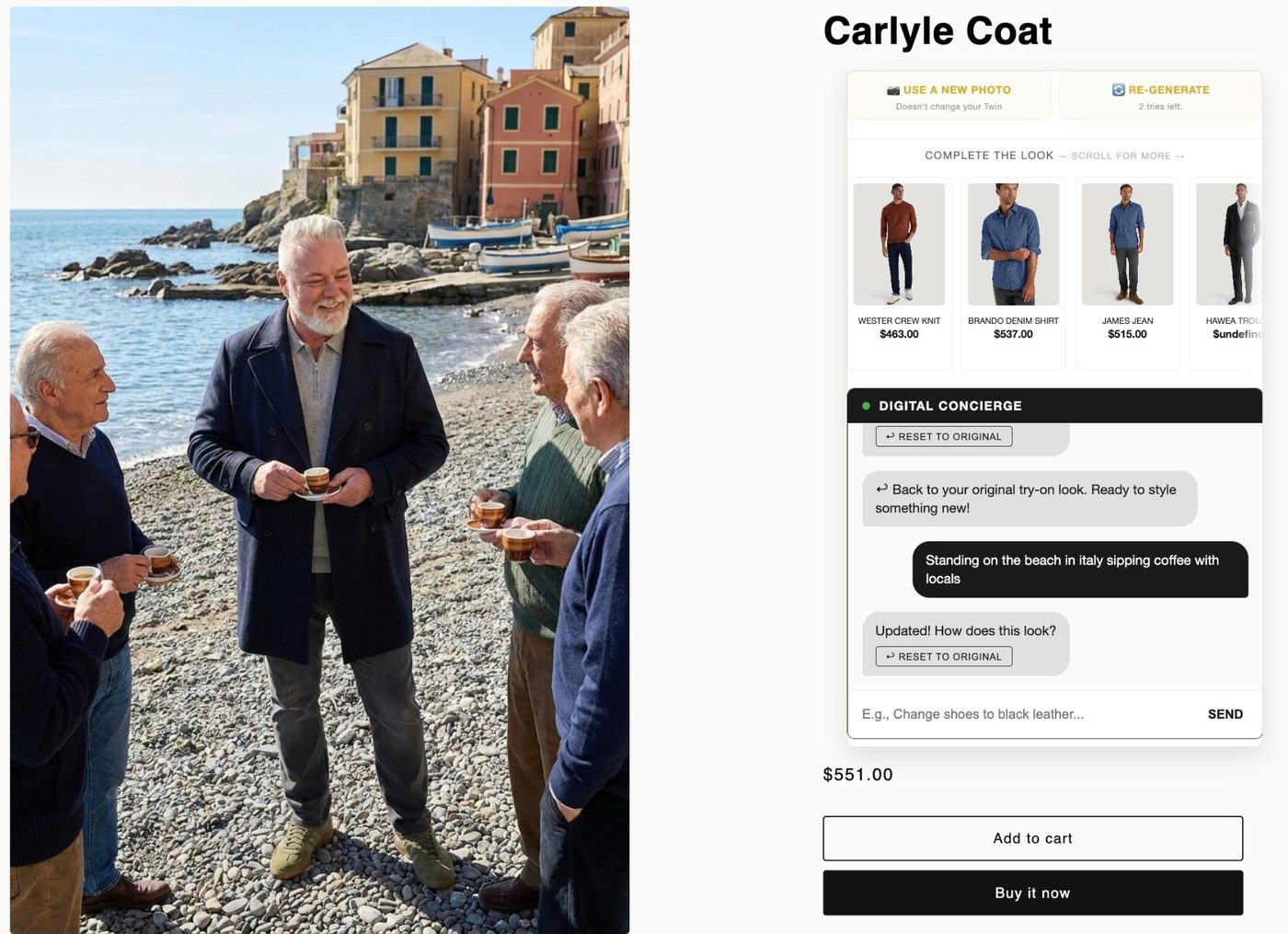
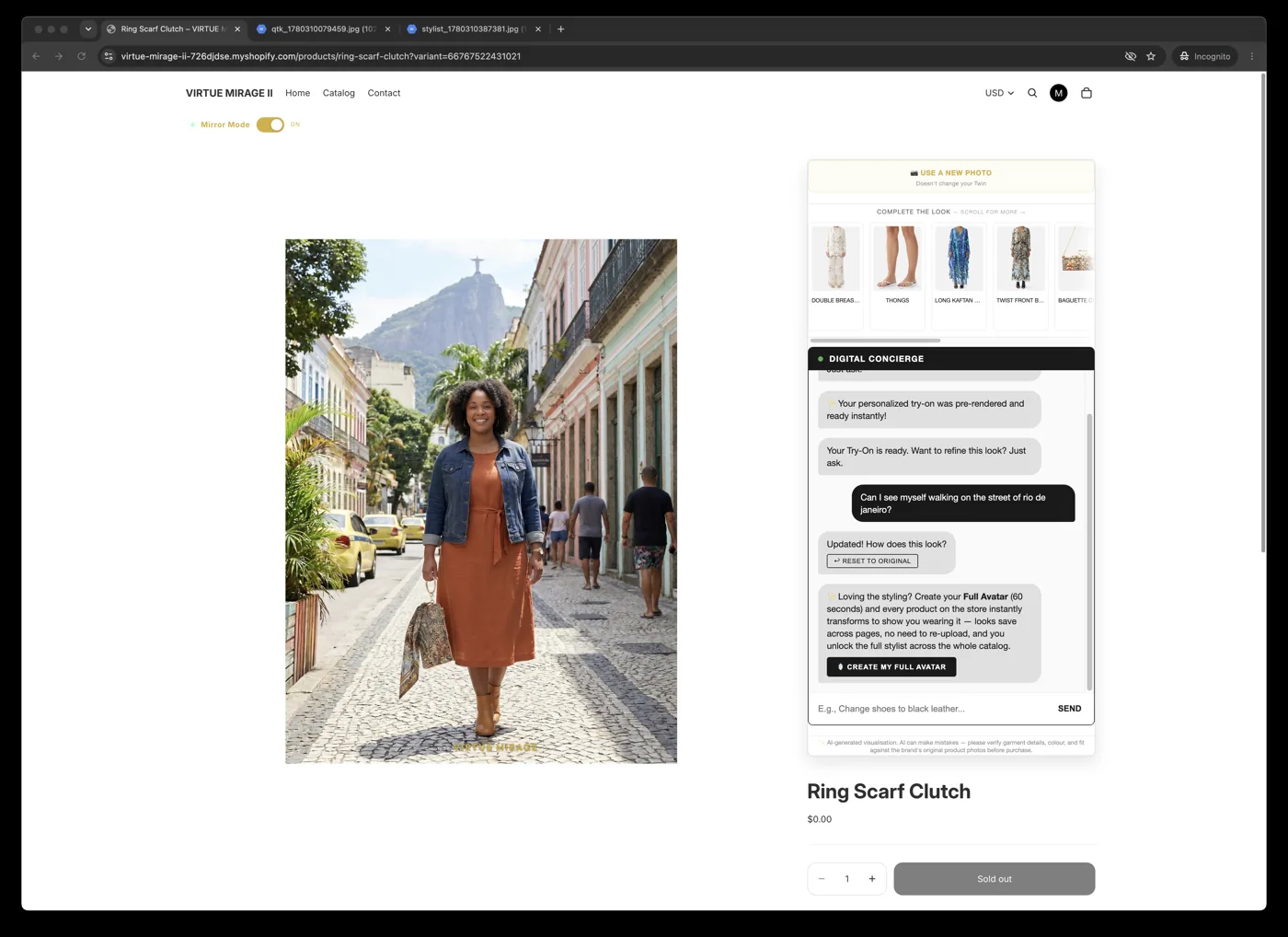
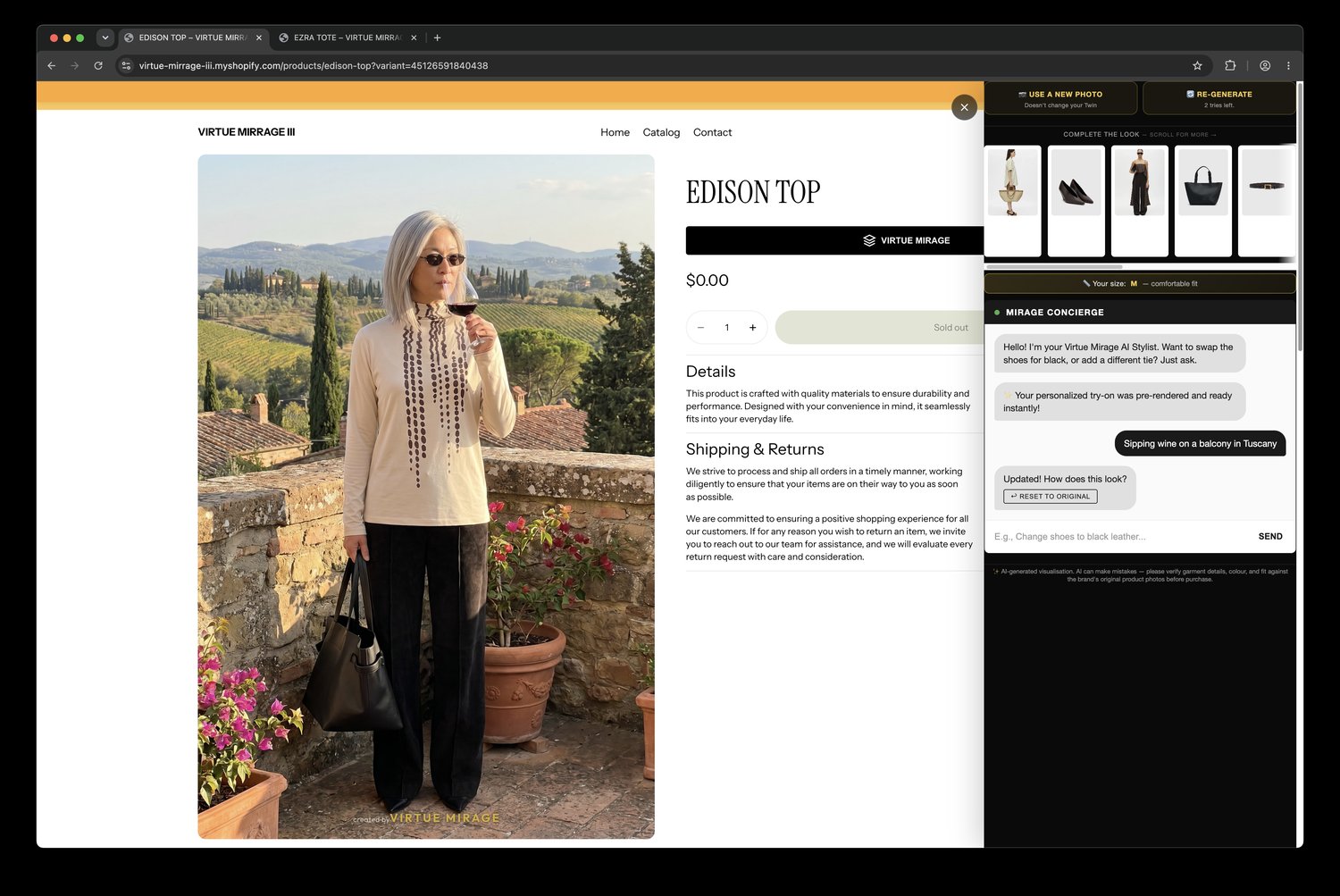
- A visual AI Stylist Concierge. The first stylist that shows instead of tells. Ask "what goes with this?" and it returns real products from your catalogue, already on the customer. Say "make the sleeves shorter," or change the whole backdrop — "put me on a beach in Italy," "the streets of Paris," "a rooftop bar in Milan" — and the image updates. Then "add it all to cart" — the whole styled outfit, conversationally.
- Visual AI measurements — see it in your size. The platform reads the shopper's measurements from their photos and maps them to your sizing matrix. So the avatar isn't a generic size-6 model — it's the customer at their real size. A size-14 shopper sees how the garment actually falls on a size-14 body, with a size recommendation on every product page. It's the bridge between the model and the mirror — and it attacks fit, the #1 cause of returns.
- A visual try-on upsell engine ("Complete the Look"). Every recommended piece is shown on the customer already — one tap to try, one tap to cart. Cross-sell that converts because they can see it.
- A cross-brand identity network. A customer who built their Twin at one Virtue Mirage brand is recognised (with consent) at every other brand on the network — so you launch with a try-on-ready audience from day one.
There's also a quieter differentiator that earns trust with technical buyers: Virtue Mirage QAs its own AI. Every render is verified against the customer's portrait before they ever see it; if a generation doesn't pass as the same person, the system silently regenerates. Bad rolls get caught in the pipeline, not on your product page.
Accessories, your own outfit, and any backdrop
It goes beyond clothing on a full avatar. A shopper can upload a photo of themselves in the outfit they're already wearing, and the store's accessories — jewellery, bags, shoes, scarves, eyewear, watches — are added onto that image, so they see exactly how the pieces look with what they already own. A bangle lands on the wrist, never a finger; shoes replace the footwear; a bag is carried naturally. It's the most natural way anyone has shopped accessories online.
And the scene is theirs to change. With a single sentence, the customer can swap the entire background and see themselves anywhere — a beach, a bar, a restaurant, the streets of Paris, a rooftop in Milan — in whatever situation they're actually dressing for. Editorial-quality lifestyle imagery, of them, in your clothes, wherever they're headed.
What's in it for the brand
Translated into the numbers a founder or e-commerce lead actually tracks:
- Fewer returns — visual sizing plus seeing the item on yourself attacks fit-driven returns, the biggest cost centre in fashion e-commerce.
- Higher conversion — confidence ("that looks good on me") is what closes the sale online.
- More leads — every guest Quick Try-On captures a consented name and email.
- Higher AOV — the Complete-the-Look concierge sells outfits, not items.
- Compounding network value — every brand that joins makes the shared audience bigger.
Privacy, properly
Because this involves customer photos, we built trust in from the start. Original uploads are deleted immediately after the avatar is created — never stored, never used for training. Identity is keyed by a one-way SHA-256 hash. Guest try-on images auto-expire. Consent is explicit and granular, recorded with timestamp. It's compliant with the Australian Privacy Act, GDPR and CCPA by design — the things your legal team will ask about, answered before they ask.
Who it's for, and how to start
Virtue Mirage is built for fashion and apparel brands that want a storefront that feels like discovery again — and the lower returns and higher conversion that come with it. The full experience is live on Shopify and BigCommerce today — and a drop-in SDK and API bring it to any other platform.
The fastest way to understand it is to see it on your own catalogue. Book a 20-minute demo and we'll show your store on your customers — no rebuild required.
Virtue Mirage is built by Virtue Creative Studios — 15 years shooting for 500+ fashion brands. We can produce the product, model, campaign and video imagery your store needs, made to work seamlessly alongside your AI try-on. See what the studio can do →
FAQ
What is a hyper-personalised storefront?
A storefront whose product imagery is generated per shopper, so each logged-in customer sees the whole store on their own AI avatar instead of a stock model. Virtue Mirage is the first to do this across an entire catalogue automatically.
Is Virtue Mirage just a virtual try-on app?
No. Virtual try-on is one capability. Virtue Mirage personalises the whole store, pre-renders new arrivals automatically, adds a visual AI stylist and visual sizing, and connects identity across brands — it's a personalisation platform, not a single-product widget.
Will it show clothes in my actual size?
Yes — that's a core part of it. The platform reads your measurements from the two photos you upload, so the avatar reflects your real size, not a generic model's. A size-14 shopper sees how the garment falls on a size-14 body, and gets a size recommendation on every product page.
Can I try accessories and change the background?
Yes. Upload a photo in the outfit you're already wearing and the store's accessories — jewellery, bags, shoes, scarves, eyewear, watches — are added onto it so you can see them together. You can also change the whole scene with a sentence and see yourself anywhere: a beach, a bar, a restaurant, Paris, Milan — wherever you're dressing for.
Is it only for Shopify?
No. Full experience on Shopify and BigCommerce today — on Shopify a Theme App Extension on any theme (Liquid, Dawn, Horizon, custom), on BigCommerce a short script snippet; installs in about an hour, no rebuild. Running something else? Our drop-in SDK and API bring try-on, sizing and the network to any platform — headless, custom, or anything in between.
What happens to customer photos?
They're deleted immediately after the avatar is generated. Only the rendered avatar is kept, and identity is stored as a one-way hash. Australian Privacy Act, GDPR and CCPA compliant.
How much does it cost?
Plans start at A$299/mo and scale to Enterprise. The per-avatar cost is absorbed by the brand, not charged to the shopper — a free experience converts better.