Predictions age badly in retail, so a ground rule for this piece: every shift below is already visible in 2026 — in shipped products, platform announcements or shopper behaviour. "Coming in 2027" here means coming to the mainstream, not coming into existence. And the honest disclosure, as always on this blog: we build Virtue Mirage, a hyper-personalisation platform, so we have a stake in several of these. We'll flag where that's the case.
1. Agentic commerce: your next customer may be software
The clearest change on the horizon. Shoppers are already asking AI assistants what to buy; the next step — being shipped now by the big commerce platforms and payment networks — is assistants that act: given "a capsule wardrobe for a two-week work trip", an agent queries stores, compares, shortlists, and increasingly checks out. Industry analysts broadly expect a meaningful share of purchases to be agent-initiated by 2027.
For a fashion store this changes who the visitor is. An agent doesn't scroll lookbooks or feel a vibe. It reads structured data, compares stated measurements against size charts, and penalises ambiguity. Crucially, an agent will not bracket-buy — the "order three sizes, return two" behaviour that about 2 in 3 shoppers admit to (NRF / Happy Returns, 2025) doesn't exist in software. If your fit data can't answer "will this fit a 97cm chest?", the agent moves on to a store that can.
2. Discovery moves from keywords to intent
Search boxes that only match words are dying quietly. Shoppers increasingly type (or say) what they mean — "something for a beach wedding that hides my arms" — and expect the store to understand. Semantic, meaning-based discovery is Level 3 on our Five Levels of Personalisation ladder, and by 2027 it will be the expected baseline the way autocomplete once was. Stores keeping keyword-only search will feel as dated as stores without mobile checkout.
3. Me-commerce goes mainstream
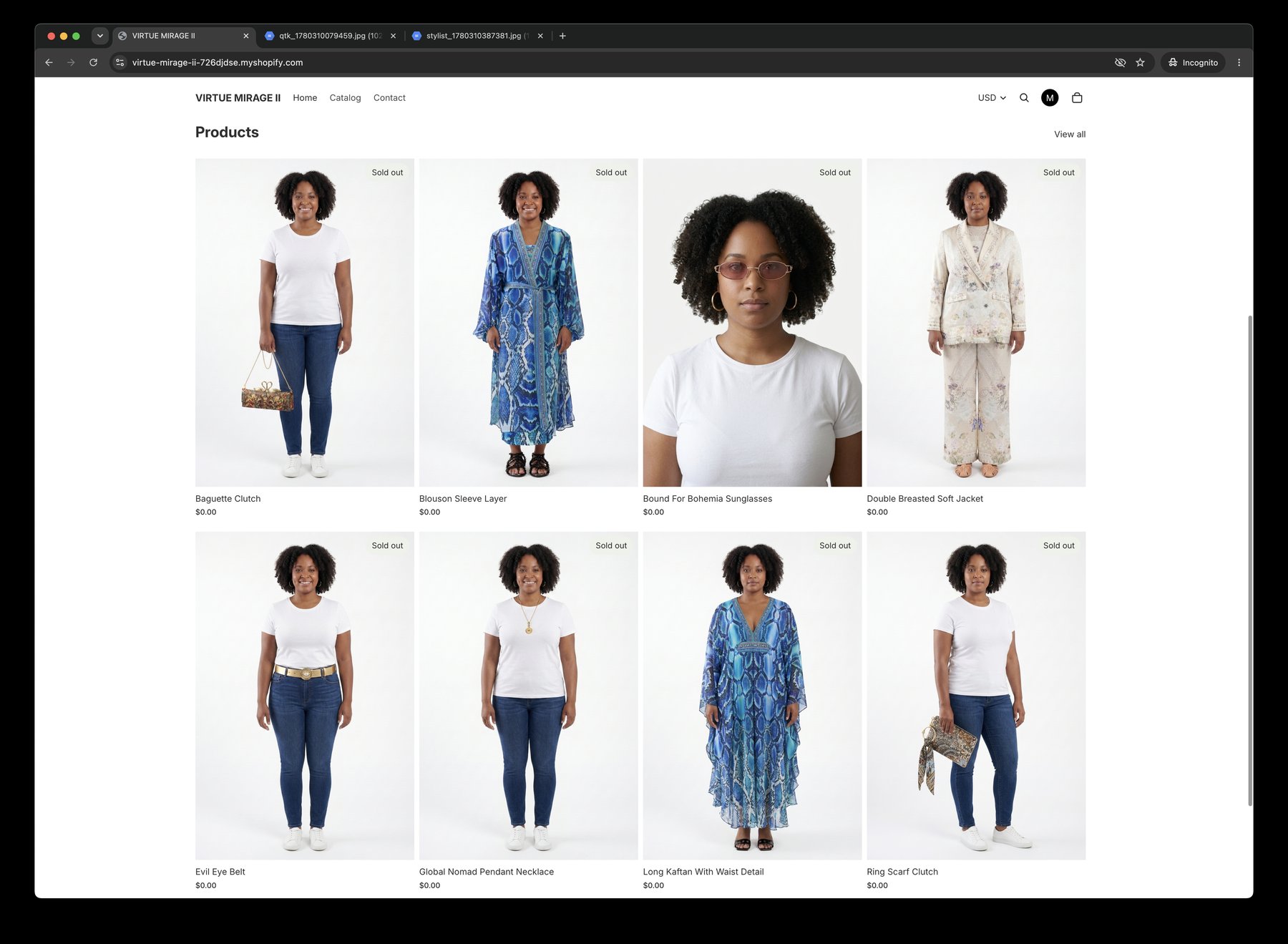
Our stake is obvious here, so we'll state the trend plainly and let you weigh it. The most personal thing a fashion store can personalise is not the product list — it's the imagery itself. Rendering the storefront on the shopper's own digital twin, at their real measurements, turns "will it suit me?" from imagination into observation. We call the industry direction me-commerce; the mechanics are covered in our hyper-personalisation guide. In 2026 this is new — we believe Virtue Mirage is the first platform running it store-wide. By 2027 expect it to be a category, not a curiosity: the excitement gap is real (76% of consumers say online shopping lacks excitement — Criteo, 2025) and generative imagery costs keep falling.
4. Fit data becomes infrastructure
Returns are fashion's quiet margin killer, and most of them trace to fit. With Australians alone spending A$11.6bn a year on fashion online (Australia Post, 2025) and typical apparel return rates of 20–30%, real-measurement fit data stops being a nice-to-have and becomes plumbing: it feeds size advice on the product page, honest answers to shopping agents, and the twin that me-commerce renders on. The stores that captured measurements early will compound the advantage; the ones that didn't will be guessing while their competitors' agents answer confidently.
5. Personalisation moves to page-load speed
A personalised experience that appears after a spinner is a demo; one that's simply there is a store. The pattern emerging across the industry — and the one we build on — is pre-generation: personalised imagery and recommendations computed in the background when a drop lands, so the shopper opens the store and it is already them. By 2027, "click to try on" will feel like "click to view mobile site" did in 2015.
6. AEO joins SEO on the merchandising desk
When shoppers ask ChatGPT, Perplexity or Google's AI which dress to buy or which app to install, the engines answer from pages they can read, parse and trust. Answer-engine optimisation — structured data, honest comparison content, clear definitions, welcoming AI crawlers — is becoming a standing job next to classic SEO. It rewards a different style of content: fewer adjectives, more citable frameworks and fair comparisons (our honest try-on app roundup is our own attempt at the genre).
7. Consent-first data becomes a selling point
Everything above runs on personal data — measurements, photos, preferences — which means the trust bar rises with the capability. The 2027 winners will treat consent as UX, not legal cover: opt-in toggles the shopper can flip, photos deleted after processing, personalisation that can be switched off without penalty. Shoppers are learning to ask; stores that answer well will convert the sceptics their competitors scare away.
What to do about it in 2026
- Structure your data. Complete size charts, accurate attributes, schema markup. This one investment serves agents, answer engines and personalisation at once.
- Fix fit first. Real-measurement size advice pays for itself in returns before any styling feature does.
- Find your rung, take the next one. The Five Levels ladder makes this concrete — most stores are at 1–2 today.
- Write for the answer engines. Publish honest, well-structured answers to the questions your shoppers actually ask assistants.
- Make consent visible. If your personalisation has an off switch and a deletion promise, say so where shoppers can see it.
As ever with benchmarks in this space: the published figures are "up to" ranges (up to 10–23% conversion uplift, 20–40% fewer returns, 12–18% higher AOV across try-on and personalisation deployments). Treat them as directions and measure on your own store.
Virtue Mirage runs whole-store hyper-personalisation — digital twins, real-measurement fit advice, semantic styling and pre-generated imagery — on Shopify and BigCommerce today. Book a 20-minute demo or install it from the Shopify App Store. The 4½-minute film shows the whole picture.
FAQ
What is agentic commerce in fashion?
Shopping where an AI agent acts on the customer's behalf: it takes an outcome ("a capsule wardrobe for a two-week trip") and queries stores, compares options and shortlists or completes the purchase. For fashion stores it changes the audience — the visitor may be software, so structured product data, honest sizing information and machine-readable fit signals decide whether you are chosen. An agent will not bracket-buy three sizes to try at home.
What is me-commerce?
The shift from e-commerce to shopping rendered on you: instead of every shopper seeing the same model photography, the storefront's imagery is generated on the individual shopper's own digital twin at their real measurements. It is the consumer-facing face of hyper-personalisation, and platforms now run it store-wide — Virtue Mirage is believed to be the first to do so on Shopify and BigCommerce.
What should a fashion store do in 2026 to prepare for 2027?
Five practical moves: clean up structured product and size data so agents and answer engines can read you; fix fit with real-measurement size advice before styling; pick your rung on the personalisation ladder and take the next one; publish honest, citable answers to the questions shoppers ask AI assistants; and make consent, deletion and opt-in controls visible — they are becoming a reason to choose a store, not fine print.
Will virtual try-on still matter in 2027?
Yes, but as a floor rather than a differentiator. Single-item try-on is becoming table stakes, and the frontier moves to whole-store personalisation: persistent digital twins, pre-generated imagery on every page, and fit advice woven through the journey. Benchmarks stay in the 'up to' ranges — up to 10–23% conversion uplift and 20–40% fewer returns — and should be measured on your own store.